Saturday, April 12, 2008

Homemade Battery Booster for ForeRunner 205/305

A common complaint about the FR 305 is the short battery life. If you are really handy, here is one way to address that problem.


"Yes, it does make an already a big watch look down right ridiculous, but it doesn't bother me after a few minutes of wearing it" says Warren, the inventor. See the discussion at GarminF Yahoo Group

Should be no problem when mounted on a bike. This one by Brad Culberson is used only for re-charging. http://www.bradculberson.com/blog/?itemid=107

Labels:

Friday, November 2, 2007

Head Cam Video at Camp Scherman in LA

The orienteering head cam was back in action at Camp Scherman!

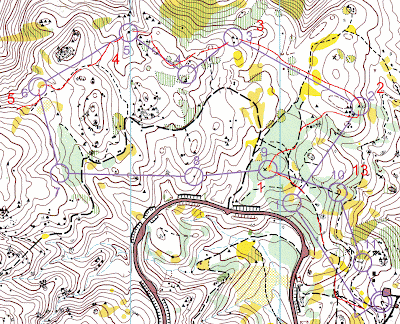
James ran the Green Course on Day 2 at LAOC's event in the San Jacinto Mountains outside of Los Angeles. The video and GPS track are synced up on VeoGeo using the same O-Gear as used at Spring Lake. My route is also sketched over the orienteering map in RouteGadget: The area was quite brushy but runnable. It took a calm concentration to just read the map, decide on a route, and execute confidently. The first day on Blue I didn't take the time and definitely was not in the flow. Day 2 I decided to run green to conform better with my (lack of) fitness these days. Taking safe routes and just pushing through with patience seemed to do the trick.

xxx

Labels: , , , , , ,

Monday, October 15, 2007

Bike Map Holder Review

Review:
http://www.racingwithgiants.com/WordPress/?p=50

The holder is available from Scarborough Orienteering with Velcro attached map case.
http://www.orienteer.com/supplies/

Monday, September 17, 2007

Head Cam Video of Sprint Orienteering Race

What happens when you combine sprint orienteering with a head cam, a GPS watch, and the new VeoGeo site? A maniacally breathless mashup!

The action is from BAOC's sprint orienteering event held at Spring Lake Park in Santa Rosa, California on September 17, 2007. The video captures controls 1-7 of James' race.

By the way, Spring Lake Park will play host to the 2009 USA orienteering team trials for the Sprint discipline.


Here are the links:
  • VeoGeo: (synced YouTube video and Gmap)
  • O-map: (scanned jpeg, so you can armchair orienteer along the way!)
The digital o-gear, as assembled by Joe:
  • Head cam consisting of Cannon SD630, foam, and elastic. It fits pretty snug actually. Started slipping a little after control 8. Original video capture is better than the YouTube compression.
  • Garmin Forerunner 305 GPS watch with heart rate monitor. Easy to operate, falling in price.
James' standard o-gear
(some pictured in this post and previously, others glimpsed in the video):
  • Brunton Jet6L thumb compass,
  • Scarborough-O magnifier,
  • First test of the new Scarborough-O "dsh-vv" description sheet holder (I usually use Silva's holder purchased in Sweden),
  • Trimtex V-Neck all-mesh top (2005 USA uniform),
  • AxisGear Atak pants,
  • Neoprene socks, and
  • Inov-8 270 orienteering shoes.
Note: On VeoGeo/Google Maps the registration of the imagery appears off ~15m to the west. The track checks out OK on other geo-referenced maps.

Labels: , , , ,

Sunday, August 5, 2007

New Control Stands

The new"Elite" control stand may soon replace the popular gooseneck design from Scarborough Orienteering, particulary in areas of firmer and rocky soils. A steel cap allows a pretty stiff hammer swing and the more robust hexagonal rod adds an aesthetic as well as practial quality. Wt. 11oz.
Also just out is the economical "SuperLite" which takes hammering as well lightness and full funtionallity of a control stand for electrionic punching.


-Joe

Monday, May 28, 2007

Inov-8 MudClaw 330 vs VJ Integrator

Conclusion: Both are great shoes for different terrain types. The VJ's with tungsten tipped spikes is great on open rock. The MudClaw 330's are lightweight with strong cleats and are superb in duff/soil. I've orienteered internationally in the VJ's for the past few years and have been running on and off trail in Inov-8's since we started testing last year.

We ran around our test loop in Joaquin Miller Park in Oakland CA with each pair of shoes. We've done the loop a few times now so have some ideas about how these different Inov-8's (and other O-shoes) ought to do in different parts. I think the VJ's do well on the rock because they have spikes closer to the edges of the sole and the studs are relatively short. Your entire weight isn't on the spikes, you just get the added traction. This gives a great all round running speed handling. The Inov-8 330's (no spikes) have more aggressive tread consisting of harder, longer, more numerous cleats. This gives a superior cornering, up/down/side hill, and stopping trust in the shoe. Great in the SF Bay Area. Construction is nice and light weight yet very sturdy for kicking through branches on purpose or getting caught up.

My only ergonomic issue with the Inov-8 330 is heal rub at the top of the shoe. I take out the insoles so the bottom of my foot is lower, thus "raising" the rim of the heal to be above my various heal bones. To be fair, my VJ's started to irritate me also but that is after many miles of wear in them. The 330's do break in after a while and adjusting the lacing helps tune the entire fit, including the heal rub. I've seen a need for break in/re-lacing to continuously fit all the Inov-8's tested thus far.

Tuesday, April 3, 2007

Headband-cam for Training


It looks like the head-cam idea for training has recieved some serious consideration. Just ran across this abstract from the SJO:

Omodei, M. M., & McLennan, J. (1995). Studying complex decision making in natural settings: Using a head-mounted video camera to study competitive orienteering. Scientific Journal of Orienteering, 11, 76-91.

Head-mounted video recording is described as a potentially powerful method for studying decision making in natural settings: most alternative data-collection procedures are intrusive and disruptive of the decision-making processes involved while conventional video-recording procedures are either impractical or impossible. As a severe test of the robustness of the methodology we studied the decision making of 6 experienced orienteers who carried a head-mounted light-weight video camera as they navigated, running as fast as possible, around a set of control points in a forest. Use of the Wilcoxon matched-pairs signed-ranks test indicated that compared with free recall, video-assisted recall evoked (a) significantly greater experiential immersion in the recall, (b) significantly more specific recollections of navigation-related thoughts and feelings, (c) significantly more realizations of map and terrain features and aspects of running speed which were not noticed at the time of actual competition, and (d) significantly greater insight into specific navigational errors and the intrusion of distracting thoughts into the decision making process. Potential applications of the technique in (a) the environments of emergency services, (b) therapeutic contexts, (c) education and training, and (d) sports psychology are discussed.

Inov-8 at the Roberts Sprint

At least six competitors in the March 31 BAOC race wore Inov-8 shoes. The Mudclaw 270 and 330 were the shoes of choice as two of the top runners placed orders after testing the 270's.

Vlad's 330's

Andrejus Masalkovas

James' 270's

The Mudclaw O+340 is not currently recommended due to a problem with the metal studs ripping out. This is otherwise a top rated shoe. The matter has been brought to the attention of Inov-8 and we hope to have word shortly on resolution of the problem.

-Joe

Monday, March 19, 2007

DIY Headband-cam

Map Video

It must be over 20 years ago that Damon Douglas, US Team coach, during a visit to the Bay Area, gave a talk on orienteering technique. For illustration he used a projected map with course while playing a tape Peter Gagarin recorded while running the course. I don't remember if the recording idea was a suggested training technique but I've used it ever since in conjunction with the map for my post mortems.

Inspired by the cyclist's helmet-cam, I thought, "why not add video?" The result is this experimental "headband-cam" fashioned from items I happened to have on hand. The idea came the night before a local sprint orienteering event (Pt. Pinole) and I figured this would be a good opportunity. So it was just a matter of luck that I had exactly the right materials and they went together easily for, at least, a workable prototype.

The camera is a 6 oz.Canon SD680 with 2GB SD card. The materials are a couple of pieces of sponge foam and elastic webbing. The foam was coincidentally the right size and had a recess to fit the camera.


The pieces were fastened together with a heavy duty stapler and a hole cut for the lens and that was it.

The results show, if nothing else, that this low tech approach has potential for presenting a view of the orienteer's experience, in action, at little cost; providing you have the camera, of course. It can effectively show the terrain, something you can only imagine from the map, useful as a tool for training, instruction and competition analysis in conjunction with a map. The video quality leaves something to be desired. Uploading to YouTube degrades the quality considerably. Google Video seems marginally better.

Probably not recommended for serious competition. The weight is acceptable but can be a distraction. The overall weight of the camera with battery and headband is about the same as a Silva orienteering headlamp without battery. A headcam is also a distraction to concentration if you are thinking about the resulting video. It seems necessary, from the example, to hold the shots of competitors, terrain features, etc. much longer than the quick glances you would normally give. Also, when map reading, the camera showed only the ground. More meaningful real-time commentary would make for even more distraction.

In this setup, the camera controls are exposed and the screen is easy to check when starting the camera. The prototype needs a retaining strap and adjustable head band.

The last couple of months have seen a huge spurt in O clips on You Tube. A lot of it is interesting and useful. I like seeing terrain types from around the world and some of the instructional stuff would be good for beginners. But there is a lot of nonsense and most seems to be overdone in terms of music and attempts at "production" and entertainment effects for my taste.

The DIY headband-cam is a simple and potentially effective way to capture some of the first-hand real time experience besides being a lot of fun.

-Joe


Monday, March 5, 2007

New Bike Map Holder

There appeared to be a void where one should be able to find a high quality/low cost bike map holder. They all seem to run in the $70-90 range. I think that has changed with Mark Manning's new rotating and adjustable entry into the market. Mark approached me a year or so ago with his aluminum fixed holder. It had a couple of rough edges and, unfortunately, did not rotate, a feature you really need in order to orient the map (which all (99% of) orienteers do.) I suggested adding the rotation and height adjustment features. He has now come out with a very slick professional product. Attaching and removing the holder from your bike is quick and easy with the snap-on no tools clamp.

I'm anxious to give it a try as should anyone looking for the ideal holder for bike-O, AR and touring. It comes supplied with attached bungee cords which makes map attachment very simple. For map protection, a larger map, unobscured, I suggest a heavy duty map case attached by Velcro. The map case idea has yet to be tested so ideas and comments on this, and the holder would be very much welcomed. Mark was kind enough to offer Scarborough Orienteering the first six off the assembly line.

As for a compass, I'm anticipating that the Silva 19 Clip will do the job just fine. The needle performance is much higher than you would expect from a $20 compass. I'm not into bike orienteering but I imagine it does not require taking precise bearings nor a state of the art needle. AR and touring require even less. Brunton no longer imports the compass so when current supplies are gone, that's it for the Clip

-Joe

Friday, February 23, 2007

MudRoc 290 and MudClaw O+340 test run

I test ran two Inov-8 shoes this week. This was a field test where we ran, changed shoes, then ran the same loop. Pavement, trail, rocky trail slope, and off trail under the Oakland Hills redwood forest.

The MudRoc 290's are a "very good" off-trail shoe. Good traction, decent cushioning, good fit, and very light. These really hit what I think of the Inov-8 niche, a well performing, light weight, and snug competition running shoe. The traction and cut-weight is not as aggressive as the MudClaw 270's - I'd say that is a good thing. We can call the 270 a more 'elite' orienteering race shoe and these MudRoc 290's probably a better trail+offtrail+orienteering shoe. I would put these on for whatever that was going to be more than trail running and pack the MudClaw 270's to compete in a more extreme race. For orienteers, these Inov-8s look like a good product duo to choose from. As mentioned elsewhere, you will need to figure out the fit/sizing for your foot.

The MudRoc O+340 I have REALLY been wanting to test for a new orienteering competition shoe: They have spikes. For me VJ/Olway, the venerable style of O-shoes from Finland, are the gold standard for orienteering racing. I consider spike tips as essential traction for rock faces, ice, and that extra edge in duff, deadfall, and regular soil.

The O+340 put Inov-8 on their way but not there. The Innov-8 signature features are there: light, tactile rubber outsole, no nonsense construction. The spikes perform well in the soft redwood understory. There are two issues I had: 1) The fit around the heal is really weird on me. The back of the shoe by my achilles feels way too low and hard. Like my original review of the 270's but with the added problem of something hard pushing into the back of my heal. I took the insole out and put wetsocks on and that got me lower in the shoe, but then the spike tops were pressing up into the bottom of my foot with each step. Issue 2) The spikes are set in soft rubber allowing, when running, movement of the spike(s) relative to your foot. This gave a non-positive feel on roads and trails, then you wonder what was happening in the duff. I also witnessed by Dad's 340 spikes start to rip loose from one of its cleats. Also heard but not personally confirmed: the spikes are just steel, not tungsten tipped for better wear.

The MudClaw O+340 is a "good" shoe. I believe that if it fits you, it will perform well offtrail. See the comment on the Dec 28 O+340 post.

But the non-spike MudClaw 270 is so "excellent"! The conundrum to work out is how can we keep a light shoe and that nice tactile rubber outsole, but give it the power of spikes? Perhaps something about how the spike plug is constructed or using a harder rubber in parts of the outsole?

Friday, February 9, 2007

Suunto Arrow 5, Mystery Solved


The Suunto, Arrow 5 is one of the best compasses on the market along with the Silva Jets and Moscow 2, 3, etc. A recent batch of Arrow 5's proved defective. Preliminary information indicated that the "B" printed on the bottom of the plate indicated that they were the southern hemisphere (zone 5) version. In checking with Suunto, Finland, I was advised that the compasses in question were indeed defective. Replacement compasses also are marked "B."

A properly balanced needle will be in line with the baseplate even when tilted and should exhibit no delay or inconsitency in settling.

Replacements are proving slow to arrive but I now have a few in stock. If you are due for a replacement and have not heard from me in a week or so, please send an e-mail. The Arrow 5 will be available at the Joe Grant meet on March 11 or by e-mail order.

-Joe

Saturday, January 27, 2007

Mudclaw 270 in the Snow


I'm out in Colorado this weekend. I have gone for two runs in snowy weather. The 270's are GREAT on fresh and packed snow. We were even in some of that breakthrough crusted snow: the shoes held up well and stayed light. Running on snowy slushy paved roads felt good.

I am wearing them with my VJ wetsocks. Works well in the conditions and help fills out the fit.

As expected, the 270's slip on the ice. But with some fresh snow on patches of ice I felt OK. But it would be great to have a spike version of this light shoe.

Wednesday, January 24, 2007

Poor Man's Ski Map Holder

Larry Berman, Berman Orienteering Supply, is running out of ski map holders for the upcoming Championships in the Sierra. He suggested simply tying a string to a map case at a minimum. Taking up on the idea I dipped into my supply of vinyl sheet protectors, stiffer, good for many uses and much clearer than your standard polybag map case. With a lanyard quality neck string you have something almost as snazzy as the $30 REI jobs good for hiking and maybe as a poor man's ski-O holder.

The next step was to make up, to some degree, for the lack of the rotation you get with the ski map holder. A second Vinyl envelope, a bunch of sticky back Velcro and you have a detachable map case that can be held in a rotated position. A Velcro tab keeps the map from falling out in the upside down position. Folded over Velcro tape reinvforces the hole for attaching the lanyard.

This is just an idea. I don't bring any ski-o experience to the table. Next in improvements might be a truly rotatable version. Then, a low cost home made harness idea might give you something close to the utility of a high tech European holder. Maybe something like Larry usually stocks or this?

-Joe

More Low Tech Stuff

Description sheets can be pretty small (sometimes even below the tiny 5mm per square IOF minimum.) This is another method of preparing them for
competition that makes good use of small size.
Just duct tape to your finger stick after backing with duct tape or, as in this case, "laminated" with clear packing tape. Running your compass lanyard through the stick strap is a good security measure.
I miss the old Silva tachometer so I attached this modified golf stroke clicker as a pace counter and it has served well for many years.
-Joe

Monday, January 8, 2007

Description Sheet Holders

I get lots of requests for wrist holders for description sheets. A couple of prototypes are in the works aimed at improving durability. The problem is in finding the time to produce them.


Pesonally, I don't care for the wrist mounting and prefer to pin the sheet to my watch band. If you don't wear a watch, a wrist sweatband works fine. If the sheets are provided in advance, this may work for you. http://orienteer.com/minidsh.htm

Friday, December 29, 2006

James' Mudclaw 270 run at Tilden

So far I like the 270: Great traction on up, down, and side hills. Nice and light. Flexible hugging construction. Yet solid.

I've done a trail run under the redwoods then an orienteering (re)run at Tilden in the Berkeley Hills.

Cons: Figuring out the sizing is a little weird. I need to run in then a couple more times and tune things. Out of the box they feel tight. After 0.5 hours of running they loosened up. Then I paused and cinched down the lacing and they look all scrunched. Now I have (unwanted) extra length in the toe. But the fit feels great.

They don't have much traditional cushioning. But the softish rubber cleat tread actually provides some. Interesting. So built for racing or off trail. My first impression is to stick with my Nike's for normal trail running.

They need spikes to be an all round O shoe. For better off trail, rock, and trail grip.

Next I'll run with these 270's again now that they're extra cinched down. Then try out the +340.

Mudclaw 270

The 270 is designed as a "fell running shoe" while the 330 and 34o are orienteering shoes, according to Inov-8. But the lighter, less cushioned, hence lower and probably more stable 270 looks like a good prospect as an O-shoe. Yesterday, James and I went to Tilden for a test run. This was a good opportunity to compare with our VJ's which we wore during a race there a few weeks ago.

My impression was very favorable. Very light but not at all a flimsy feel. The off-center lacing and is a little unnerving but the construction, as with the 34o appears very solid. Traction is more than adequate. My preference, again would be for a higher upper in the heel area. With my wide feet, I tend to have slippage back there but as I usually tape my ankles outside the shoe, I don't expect this to be a problem for me.

Thursday, December 28, 2006

Mudclaw 'O' +340

I got a shipment of some Mudclaw 270, 'O' 330 and 'O' +340's the other day for testing and sale. They look great as conveyed in the photos. The Mudclaw and possibly some of the other sole patterns of the Inov-8 line of terrain shoes has the promise of a really good O-shoe, light but adequately cushioned with good support and excellent construction. Most impressive is the very aggressive studding AND, on the 340's (pictured,) dobb spikes.

A jog in the redwoods included some steep ups and downs in deep duff and a downhill on a steep downslope with loose gravel. No problem
with the traction. The shoes are light light ( and comfortable for me. The high studs tak a bit of getting used to especially for me as I wear orthotics. This caused some heel slippage on the uphills. Really cinching down on the laces took care of most of this as might a half size smaller.

The Inov-8
web site, from England, shows a lot of attention to research and design, something that would be good to see from other manufacturers. A page with "reviews" is suspiciously short on negative comments.


Personally I would like to see the uppers a little higher in the heel area. Others will appreciate low tops for flexibility and lack friction. For some the long and numerous studs may take getting used to but for traction on the steep Bay Area hills, they may be the ultimate now that full spikes are no longer available. For those that find them overkill, the Mudroc 280 appears to have something close to a conventional O-stud. James and I plan on checking out the 270 next.

Before the shipment arrived I discovered that Vladimir Gusiatnikov wears the 270 and 330. The meat of what he had to say:

From Vlad on 12/14
I have two orienteering-suitable pairs: Mudclaw 270 and Mudclaw 330.
Both are more of a running shoe than an O-shoe in terms of fit and feel. For my technique, the 270 is clearly better. The 330 is bulkier, the heel sits higher offthe ground, and is heavier. And, I got a huge blister with the 330.
The main benefit of the 270 vs. the Integrator or the Falcon is that it is stable on my feet. They don't rotate, and when they get wet, they keep the original shape. They are about as light as the Integrators. So, I would rather contour around a Bay Area hill in the 270s than the Integrators.
Neither the 270 nor the 330 has metal cleats, a clear disadvantage on wet rocks or slippery eucalyptus branches like last Sunday at Tilden.
Vladimir


And on 12/19
At 16:14 14 12 06, you wrote:
>Thanks for the feedback. I take it that you give the shoes a generally favorable recommendation. Any thoughts on durability? In looking at reviews, a common complaint is about shoes that "fall apart."


I don't know. Too early to tell. There are no signs of fallingapart in either shoe yet, after less than a month of use. When theydo fall apart, my Attackpoint log should give the fall-apart mileage.

>Do you see any advantage to the 330 over the 270 other than your fit? How about otherwise for support? Apparently it has more in the way of cushioning which may be counterproductive as to weight and stability.

Correct. I did the Muir Beach Trail Run in the 330s, and was happy about that over the 270s. On the downhills, the cushioning came handy. I think the steep, hard trails in the Headlands may be too much for the 270s. On the other hand, jogging at Bon Tempe felt fine in the 270s. In either case, I'd say I had a better experience in the Inov-8s vs. the Falcons or Integrators.
In summary, the fit of the Inov-8s may contribute to the feeling that you may go out of control on the downhills and the sidehills, but it's just the opposite. I was never close to twisting my ankle.
Vladimir